Showing posts with label egalitarianism. Show all posts

Saturday, November 24, 2018

Capitalism ⬌ Socialism: The Other Economic Stagnation


When skilled and unskilled people living in the digital age are asked about the sharpest divides behind economic belief, responses indicate that Socialism vs. Capitalism is (still) where it's at. It will come as no surprise that I am far from convinced that bifurcating economics along this especial a lane is coherent or productive in 2018. That is, once one applies exclusively forward-looking criteria for determining what we have most reason to dispense with and what we'd do well to preserve.

If this comes across as a pitch for the Mixed Economy as the only way forward, it goes to show just how attentively propagandized things are. There's a multitude of so-called Third Ways. Some of them incorporate aspects of ― or the totality of ― the LTV. It would be more accurate to refer to these buried models as Fourth Way, Fifth Way, etc. That won't happen, and each of those highly multifaceted mixed systems will continue to receive zero airtime and attention. So the next time you hear about the drawbacks of the Mixed Economy, try to point out that "it" has as many if not more offshoots as all the unmixed doctrines do.

Hair-splitting example: Whether an economy is mixed or unmixed says nothing about whether it is ultimately grounded in steady-state precepts or in unfettered "growthism". Visual aid time:

Tuesday, August 8, 2017

The Shallowness Of Intersectionality


Ethnicity & Sexuality

Փ

We must understand that patriarchal domination shares an ideological foundation with racism and other forms of group oppression, and that there is no hope that it can be eradicated while these systems remain intact. This knowledge should consistently inform the direction of feminist theory and practice. (hooks 1989: 22)

An unexamined double standard looms over thinkers and activists who nod along to quotes like this. The basic flaw is now glaringly noticeable, enough to turn me cantankerous with the willfully blind and accordingly doubtful of my ability to remain sufficiently constructively critical and non-polemical throughout this post. Despite this, my aims are high. More steeply though, concerning the specific quote, the same conviction implicates anyone who traverses racial and sexual (and other group-interest) politics from uniformly reparative angles. This holds regardless of whether the ends of a particular reparative expedition happen to be identical or similar to the ones that this quote by hooks seeks to activate and energize, and regardless of whether the reparation-seekers are at all conversant with the works of someone like hooks.

If a reparative project is anything, it is past-centric and morally transitive. While understandings of reparation can and do vary from theory to theory, all theories hold in common a central premise; their justificatory force calls for a "Past Lives Matter" criterion of reciprocation and rightness. Among other troubling things, this approach sees inter-group reparation advocates under the thumb of distributive schemes which, even in practice, so in direct policy terms, are willing to dethrone strict neutrality when doing so is the only means of securing Intergenerational Restorative Justice. So it would be wrong not to lend greater weight to a past-centered brand of justice over the more customary ideals which fasten legal and procedural neutrality across all non-dead individuals.

It gets worse. To help right past wrongs, members of certain groups are encouraged to view their raw subjective experiences as epistemic leverage for arriving at answers to questions of evidentiary import. The theories encouraging this know to adjust for varying levels of past injustices, meaning some maltreated groups (i.e. visible minorities) are afforded more first-person laxity than other maltreated groups, though this is controversial and inessential for the main tenets to be introduced.

The uncontroversial tenets hold that the more Historically Wronged groups one belongs to, the more first-personal, internally-crafted hardship cred one secures for oneself. The fewer Historically Wronged groups one belongs to, the less first-personal, internally-crafted hardship cred one secures. The upshot is that, for one particular group, no such clout is plausibly on the table. At least insofar as its members live in the West. For them, any admissible evidence and reason-giving is necessarily third-personal, statistical and otherwise non-experiential. And even then, you can't help but wonder about the hidden effects on conflict resolution. Under a selective-leverage regime, the inputs and arguments of western men, no matter how careful and aspirationally third-personal their contributions prove to be, remain open to overruling via the anecdotal tales and antics of those whose membership in one or another officially recognized marginalized group is accepted by all parties. This alone seems to not be worth the price of admission, reparation be dammed.

None of this is to suggest that the traditionally minded opponents of intergroup-reparation are altogether insusceptible to the double standards I intend to unveil here. No one is foundationally immunized from the alluringly uneven leverage oversight, no matter their professed or revealed beliefs. It just so happens that the epistemic blinders and loosened standards I'll be focusing on here are less likely to take hold as traditionalistic dogma enters the fray. How can this be? The reasons are stretchable and mazelike, intended for the diligent and temperamentally mature reader who fires no shots at the messenger and who assesses what the post is getting at incrementally.


It is commonly said that, within private affairs, or in largely depoliticized contexts, inquisitive non-judgmentalism is the best social attitude to have. When a personal choice doesn't linearly harm anyone, the choice cannot be unethical or immoral, even when it is self-indulgent or beneficently avoidant. Here a self-seeking agent's total disinterest in supererogation can at most inspire advocates of social non-judgmentalism to rely on softer terms like morally wanting, but never morally worse or wrong. In turn, voluntary associational selectivity now enjoys a cordial amoral status. And if this freely empowered association doesn't enjoy it beyond the progressive havens of the West, well then it certainly ought to, provided that all such associations are shown to be in unison broadly harmless. This, if social non-judgmentalists are going to have their say.

So when we choose to befriend Travis and avoid Melvin, we are not acting ethically or unethically. Our personal choices are just not apt for this category of scrutiny. These decisions can be prudent or imprudent, leaving them open to a yay/boo feedback mechanism from onlookers; presumably from a small number of people only, like close friends and family members. But even with those we know extremely well, the feedback is (ideally) always cashed out in distinctly non-moral forms of normatively-laced approval or disapproval. A student receiving an A or an F on a test, for instance. The grader, if he is a licensed professional, knows that he has no business casting positive or negative forms of moral judgment on the student for his performance, in line with the student's A or F. In fact, it will not even occur to the grader to overextend ethics and moral sense into this, at least once we stipulate that this grader is well-read on, and is genuinely convinced by, some of the more credible ethical theories around. The same goes for the friendship decision above. There are reasons for pushback or pressure from others, but those reasons take the form of bolstering prudence and skirting imprudence. And it stops there.

Things weren't always this unintrusive. Thankfully, hard-fought lessons have been extracted from the more intrusive days, despite how tediously gradual and drawn-out escaping them has been. But escape those days we did. For this, westerners have generic progressivism to credit, or whichever subsection of progressive politics you feel deserves props for pushing the West away from senseless trad-taboos and delivering us here.

Culturally induced monogamy, therefore, has also had its day. Its replacement doesn't implore widespread support from any dominant culture. Instead, it demands that promiscuous and non-monogamous choices not be condemned the way they were prior to the sexual revolution. As with other types of pursuits, the lifestyle stakes are (said to be) neither good nor bad. They just are, and they ought to be respected or tolerated. Respect and/or tolerance applies to intimate choices when those are assortative as well as when they prove to be post-assortative.

The setup goes something like: There are rights and there are responsibilities. Civic norms operate on the give-and-take between the two. The freer a society is, the more progressive it becomes, the more roominess it affords to arbitrary favouritisms within apolitical domains. Trying to outrun the inescapability of instinct and choice, once all impersonal responsibilities are fulfilled, is a fool's errand. Seek to stultify this progress and be met with reminders that what goes on consensually behind closed doors is no one's business dammit. Alright then.

Wednesday, April 15, 2015

Inequality vs. Disutility

Enduring mantras defending or agitating against 'inequality' rarely engage with a careful parsing of egalitarian ethics. The internet being what it is, even a teensy definitional oversight can spiral into wasted energy and communicational brick walls. Debates surrounding the intrinsic status of equality/inequality are not immune to this, as it turns out. Shocker.

To bypass –– in one fell swoop –– the pratfalls of opportunistic demagoguery and mindless sanctimony, we direct people to the segmentations between numerous schools of egalitarianism:


Numerical Egalitarianism:

Treats all moral patients as indistinguishable, apportioning the same quantity of a good per capita.


Proportional Egalitarianism:

Treats all moral patients in accordance to their distinct needs.


It’s hard to overstate how useful it would be to have interlocutors who actually pay attention to “numerical vs. proportional” parameters instead of carrying on as if everyone holds the same idea of what is meant whenever “equality” is uttered. With policy-related discussions, it would be doubly useful to qualify one’s views in this way.


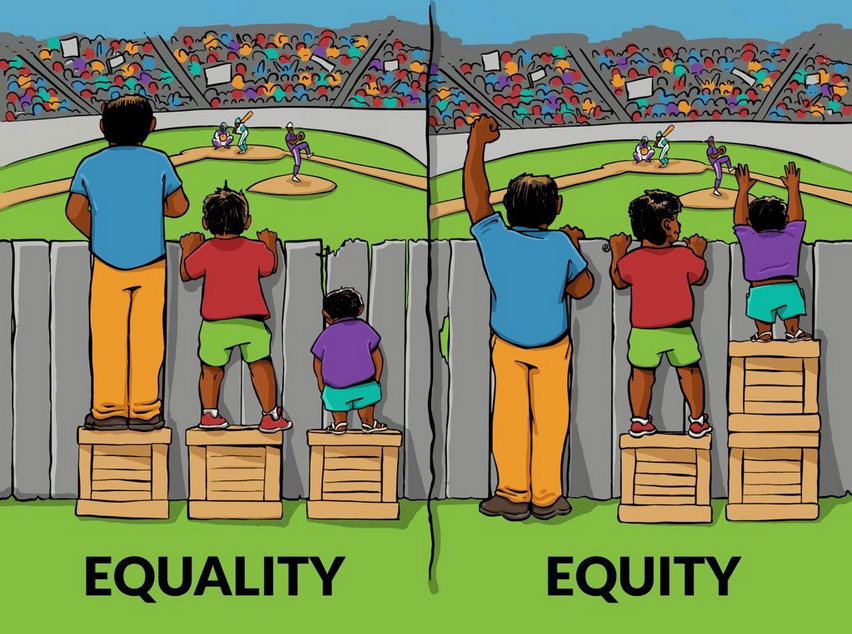
Failure to conceptualize and frame the issue along these lines enables this type of irritable backwardness to turn up as the top result for "equity vs. equality" keyword searches:


There is no need for words like "equity" when we have Proportional Egalitarianism covering the same ground going all the way back to Aristotle. It would be a different story if all modes of equality had been conceived to march to the tune of Numerical Egalitarianism, which they weren't. So as things stand, equity = another case of word-abundance. There isn't a single mention of it in the SEP's lengthy article on equality and related concepts.

There's also the problem of equity being used varyingly depending on the region you're in. In the above image, equity corrects for natural disadvantages in ways that equality presumably cannot. But this tends to not capture ordinary people's view of equality, at least in my experience. People tend to think of equality in proportional terms more often than in numerical ones. Whereas when someone says "equity" or "inequity" around me, it's clear that they're referring to a meritocratic value / unmeritocratic disvalue, reserved mainly for the competitive domains of life.

The winner of an athletic contest, for instance, should be the athlete who outperforms all of the competitors, regardless of each competitor's sympathetic backstory, and regardless of who wanted the victory more. Any privileging of the losing athletes based on their having had worse struggles and sobs-stories would qualify as a strike against equity, rendering the contest inequitable on the whole. No one in my neck of the woods uses the word equity to refer to the elimination of natural bads, but it's how the above image would have us use it. 

At the same time, athletic competitions start to seem insignificant when compared to competing political [distributive] theories. And at the same-same time, it's also crucial to acknowledge that our political aims don’t transition seamlessly into our ethical aims. There is a reason for why political philosophy is little more than a synonym for moral philosophy. A relationship between the two should no doubt exist, but this relationship must be a sinuous one. Legality has to do with civilizational strategy, which may ultimately (indirectly) lend a helping hand to ethical know-how. That's the goal, anyway. As such, every policy comes with telic constraints, provided that politics ought to compliment ethics when all is said and done, which I believe should be the case.

Saturday, January 31, 2015

Consequentialism vs. Non-Consequentialism vs. Moral Particularism

Update 2015-10-15: This was written prior to my discovery of Dual Consequentialism which is something of a game changer. Current view: Panoramic attentiveness to outcomes don't necessarily faze out particularistic evaluations of aggregation. A principled devotion to aggregation entails a one-size-fits-all aggregative calculus, which I find morally monstrous. Despite this, there is no immutable antagonism between particularism and consequentialism when one's particularism is sensibly forward-looking. I suppose backward-looking particularism is a possibility, but I am yet to see a deontologist, for instance, shun Principlism in its favor. It's not hard to see why. To ground 'shouldness' in deontic ways entails a deference to principles, which runs contrary to particularism simpliciter. Thus the spat between the consequentialist and the particularist isn't an unfailing one. The forward-looking particularist and the [dual] consequentialist may perceive each other as moral chums, when all is said and done. Still yet, most applications of consequentialism do not encourage dual-ranking verdicts, at least not in the way I construe dual-ranking verdicts, which may well be idiosyncratic. Nor are most consequentialists quick to side with multi-dimensional aggregative schemes over unidimensional ones. In light of this, the below points remain worthy of consideration.